
Quick Answer
Most bees around a Calgary home can be moved instead of killed. Watch them first. A quiet cluster hanging from a branch is usually a honeybee swarm, and a beekeeper will often collect it for free. Colonies inside walls, decks or lawns need trained hands. Spraying, sealing or flooding a nest yourself is what turns a minor problem into stings, stained drywall and a repeat visit next spring.
Introduction
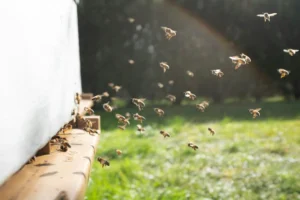
You step outside with your coffee, and something is off. A thin stream of insects is slipping under the siding near the eavestrough, one after another, merging into the gap like traffic onto Deerfoot. It has probably been going on for weeks without you noticing. Your first instinct is the spray can in the garage, and that instinct is usually wrong.
Plenty of homeowners feel the same way, which is why so many of them look up bee removal services in Calgary before touching anything. Slow down, watch for a few minutes, and work out what is actually living there.
That pause affects the cost, the odds of getting stung and whether the colony survives. So start with the insect itself.
Honeybees, Bumble Bees or Wasps: What’s Actually Nesting Here
Before you decide how to get rid of bees, the insect needs a name. A honeybee colony and a wasp nest call for nearly opposite treatment, and guessing wrong costs you money or a swollen forearm.
Bee vs wasp identification from a safe distance
Thirty seconds of watching from six feet away tells you most of what you need:
| What you see | Likely a honeybee | Likely a wasp |
| Body | Fuzzy, rounded, amber-brown | Smooth, shiny, sharply striped |
| Waist | Thick, barely defined | Pinched, very narrow |
| Flight | Slow, often loaded with pollen | Quick, darting, hovering |
| Nest | Waxy comb hidden in a cavity | Grey papery ball or flat disc |
| Near your BBQ | Almost never | Constantly |
Wasps hunt meat and sweet drinks. Bees ignore your burger entirely. That one habit is the clearest tell on a back deck in August.
Where the nest sits changes the whole job
Location drives the difficulty more than the species does. The usual spots around local homes:
- Hanging in a tree or on a fence rail, which means a temporary swarm, often gone within a day
- Inside a wall cavity, soffit or chimney, which means an established colony with comb and stored honey
- Under a deck or shed floor, usually wasps, occasionally bumble bees
- Straight into a hole in the lawn, which means solitary native bees
That last one surprises people. About 70 per cent of Alberta’s bees nest underground, living alone with no queen or hive to defend. They sting only if squeezed, and they vanish on their own by late summer.
Leave it, move it, or treat it
Species plus location usually points to one of three outcomes, and the bee removal Calgary homeowners arrange is rarely the aggressive kind.
- Leave it. Solitary ground bees, mason bees and a swarm resting overnight need no action at all.
- Relocate it. A swarm or an accessible colony can be collected alive by a beekeeper and rehomed to an apiary.
- Treat it. Reserved for wasps, or for a colony buried so deep in a structure that live extraction would mean tearing out half a wall.
Why pulling a colony out of a wall takes hours
Honey bee removal Calgary homes need is rarely a spray-and-leave job. A mature colony inside a wall holds several kilograms of wax, brood and honey. The work runs roughly like this:
- Pinpoint the cavity, often with a thermal camera or by tapping and listening
- Cut a small access panel through the siding or drywall
- Lift the comb out in sections and transfer the brood into a transport box
- Find the queen, since the colony follows wherever she goes
- Scrape every trace of wax and honey from the void
- Seal the entry point so scout bees cannot move back in next spring
Skip that cleanup and the leftover honey ferments, seeps through drywall, stains ceilings, and draws ants, mice and a fresh colony the following year. All of that assumes somebody got called in the first place, which is where most of these situations actually go wrong.
The First Hour After You Spot a Nest, and the Months That Follow
Finding a nest is stressful, and stress produces bad decisions fast.
Five things to skip
- Spraying wasp foam at a honeybee colony, which kills the bees and leaves the comb rotting inside your wall
- Plugging the entry hole, which pushes a trapped colony inward toward your living space
- Pouring gasoline, bleach or boiling water into a ground nest
- Knocking a nest down with a hose or a rake
- Letting kids or pets play within a few metres of the flight path
Who to call, and in what order
Your next move depends on what you found:
| Situation | Who handles it |
| Honeybee swarm clustered outdoors | City 311 line or the local beekeepers association, which dispatches volunteer swarm catchers |
| Colony established inside a structure | A licensed operator experienced in live extraction |
| Wasps anywhere near a doorway or deck | A licensed pest technician |
| Ground bees in an unused corner of the yard | Nobody. Mark the spot and wait them out |
Swarm season peaks in late spring and early summer, when crowded hives split and a new queen leads half the colony off to find a home. Those clusters are docile and usually collected at no charge. A colony that has been building since June is a different job, and the price climbs with how much siding or drywall has to come off.
Questions worth asking before you book
If you are comparing the bee removal services Calgary has on offer, these five answers tell you more than the quote does:
- Do you relocate live colonies, or only treat them?
- Is comb and honey removal included, or billed separately?
- Who repairs the siding or drywall afterward?
- Are you licensed and insured in Alberta?
- Is there a warranty if they come back next season?
Sealing the gaps before next spring
Once the yard is clear, one autumn walk-around prevents most repeat visits. Seal gaps around utility lines, screen the vents and chimney cap, replace cracked soffit panels, and clear fallen fruit before it ferments. Scouts start searching for cavities in April, so anything closed by October rarely becomes a problem.
Why the Spray Can Should Be Your Last Resort
Absolute pest control, meaning a property with no insects on it whatsoever, is neither achievable nor something you actually want. Pollinators are part of what keeps local gardens and Alberta crops producing. The useful goal is narrower: know what moved in, judge whether it poses a real risk, and hand the rest to someone trained for it.
Most of these stories end well. A swarm gets collected and rehomed, a wall colony comes out and the cavity gets sealed, a patch of ground bees quietly finishes its season. The ones that end badly almost always start with a pressurized can and a rushed decision.
So take the thirty seconds to look properly, keep your distance, and make the call instead.