
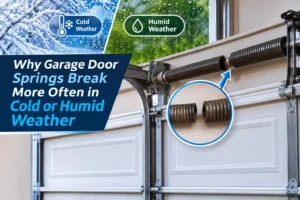
This article was written by an independent contributor and is not from Homoper’s editorial staff. The views and opinions expressed are solely those of the contributor and do not necessarily reflect those of Homoper. This post may contain links to external websites. The inclusion of these links does not constitute an endorsement of, or partnership with, Homoper, and Homoper is not responsible for the content or practices of any linked third-party sites.
A garage door is one of the most frequently used systems in a home, but its springs rarely receive attention until something goes wrong. A door that worked perfectly the previous evening may suddenly refuse to open the next morning. Sometimes, homeowners even hear a loud bang from the garage before discovering that the door has become unusually heavy.
In many situations, a broken spring is responsible.
Garage door springs are designed to handle repeated mechanical stress, but their performance can be affected by several factors. Temperature changes, moisture exposure, corrosion, improper installation, and regular wear can all contribute to premature failure.
Understanding why garage door springs break is particularly important for homeowners living in areas with changing weather conditions. Recognizing the causes and warning signs can help prevent unexpected breakdowns and reduce the risk of damage to other garage door components.
Understanding the Role of Garage Door Springs
Garage door springs do more than simply help a door move. They counterbalance its weight, allowing the door to open and close without placing the entire load on the opener.
Most residential garage doors use one of two spring systems.
Torsion Springs
Torsion springs are generally installed horizontally above the garage door opening. They store mechanical energy by twisting as the door closes and release that energy when the door opens.
These springs are commonly used in sectional garage doors and are designed according to the door’s weight, dimensions, and operating requirements.
Extension Springs
Extension springs are typically positioned along the sides of the horizontal tracks. They stretch when the door closes and contract when it opens, helping support the door’s movement.
Both types experience repeated stress during normal operation. Over time, this repeated loading can cause metal fatigue, eventually making the spring more likely to break.
Why Garage Door Springs Break More Often in Cold Weather
Cold weather is often blamed when a garage door spring suddenly fails. However, low temperatures are not necessarily the original cause. In many cases, the spring has already experienced years of wear, and seasonal conditions expose an existing weakness.
Several factors can contribute to this problem.
1. Repeated Stress Weakens the Spring Material
Every time a garage door opens and closes, its springs experience mechanical stress. This process repeats thousands of times throughout their service life.
Over time, microscopic changes in the metal can develop through a process known as metal fatigue. Eventually, the spring may lose its ability to withstand normal operating forces.
A cold morning may simply be when an already weakened spring finally snaps. This explains why homeowners sometimes associate spring failures with the first major temperature drop of the season.
2. Cold Conditions Can Affect Moving Components
Garage door springs work alongside rollers, hinges, tracks, bearings, and cables. If any of these components become difficult to move, the entire system may experience additional resistance.
Cold conditions can affect certain lubricants and make some rubber components less flexible. In particularly cold environments, moisture near the bottom seal can also freeze and interfere with door movement.
When the door encounters resistance, its counterbalance system may experience additional operating stress.
The important point is that a garage door should move smoothly. Unusual resistance, grinding noises, or jerky movement should be investigated rather than ignored.
3. Temperature Changes Can Expose Existing Weaknesses
Steel responds to temperature changes through expansion and contraction. Although normal seasonal temperature changes do not automatically cause a properly selected spring to break, an aging or damaged spring may already have reduced fatigue resistance.
A spring with existing cracks, corrosion, or excessive wear may eventually fail during an ordinary operating cycle.
This is why spring condition, installation quality, and usage history are generally more useful indicators of expected service life than temperature alone.
How Humidity and Moisture Contribute to Spring Failure
Cold weather is only part of the problem. Humidity and moisture can also affect garage door springs, particularly when metal components remain exposed to damp conditions.
1. Moisture Can Cause Rust and Corrosion
Most residential garage door springs are manufactured from steel. When steel is exposed to moisture and oxygen, corrosion can develop on its surface.
Initially, rust may appear as small brown or reddish spots. Over time, corrosion can create pits and reduce the effective cross-sectional area of the spring wire.
These damaged areas can become weak points where fatigue cracks develop.
The Door & Access Systems Manufacturers Association (DASMA) identifies corrosive environments as one of the factors that can reduce spring cycle life. Its technical guidance also discusses the effects of moisture exposure, coastal conditions, and certain chemicals.
2. Salt in the Air Can Accelerate Corrosion
Homes located near coastal environments may experience additional corrosion risks because airborne salt can contribute to the deterioration of exposed metal components.
Salt and moisture together create conditions that can accelerate corrosion compared with exposure to ordinary dry air.
This is especially important for garages where doors remain open for extended periods or metal hardware is regularly exposed to outdoor conditions.
Choosing appropriate components and following manufacturer maintenance instructions can help reduce unnecessary deterioration.
3. Poor Garage Ventilation Can Increase Moisture Exposure
A garage does not need to be directly exposed to rain to experience moisture problems.
Wet vehicles, water leaks, damp storage materials, and limited ventilation can contribute to elevated humidity inside the garage.
When moisture repeatedly collects on metal components, corrosion may develop over time.
Homeowners can reduce unnecessary moisture exposure by repairing leaks, improving ventilation where appropriate, and keeping the garage reasonably dry.
4. Corrosion Can Make Fatigue Damage Worse
Corrosion and metal fatigue often work together.
A spring already experiences repeated stress whenever the garage door operates. When corrosion creates pits or damaged surface areas, those locations may become more vulnerable to fatigue cracking.
As the spring continues operating, cracks can gradually develop and grow until the material can no longer withstand the applied force.
This is one reason visible rust on a garage door spring should not be treated as a purely cosmetic issue.
Other Reasons Garage Door Springs Break
Weather conditions are not the only explanation for spring failure. Installation problems, incorrect sizing, and everyday usage can also shorten the service life of a garage door spring.
| Common Cause | How It Affects the Spring |
|---|---|
| Normal wear and tear | Repeated operating cycles gradually weaken the metal. |
| Incorrect spring sizing | The spring may not properly counterbalance the door’s weight. |
| Poor installation | Incorrect setup can affect spring performance and service life. |
| Excessive door weight | Additional weight can place greater demands on the counterbalance system. |
| Corrosion | Rust and surface damage can create weak points in the spring wire. |
| Frequent operation | Higher daily usage increases the number of completed cycles. |
| Lack of maintenance | Developing problems may remain unnoticed until failure occurs. |
How Many Cycles Can a Garage Door Spring Last?
Spring lifespan is often measured in operating cycles rather than years. One complete cycle generally means one opening and one closing movement.
A commonly referenced residential spring rating is approximately 10,000 cycles, although higher-cycle options are also available.
Actual lifespan depends on the spring’s specifications, door weight, installation, environmental exposure, and daily usage.
For example, a household that opens its garage door several times every day may reach a spring’s rated cycle count sooner than a household with less frequent use.
Warning Signs That a Garage Door Spring May Be Failing
Garage door springs do not always show obvious signs before breaking. However, certain changes in door operation can indicate that the spring system needs attention.
A Loud Bang From the Garage
A torsion spring can make a loud snapping sound when it breaks. Homeowners sometimes mistake this noise for something falling or hitting the garage floor.
If you hear an unexpected bang and the door stops operating normally, avoid using it until the system has been inspected.
The Door Suddenly Feels Heavy
A properly balanced garage door should not require excessive force to move.
If the door suddenly feels much heavier than usual, the spring system may no longer be providing sufficient counterbalance.
The Garage Door Opens Only a Few Inches
An automatic opener may struggle to lift a door when a spring has failed. The opener may stop operating because the door’s weight creates excessive resistance.
Continuing to press the remote can place additional strain on the opener.
A Visible Gap in the Spring
A broken torsion spring often shows a visible separation between the two sections.
Homeowners may be able to identify this problem from a safe distance without touching the spring or surrounding hardware.
Uneven Door Movement
A garage door that appears crooked or moves unevenly may have a spring, cable, track, or other mechanical problem.
It is important to have the complete system inspected instead of assuming the spring is the only component involved.
How to Reduce the Risk of Garage Door Spring Failure
Although no maintenance routine can prevent every spring failure, proper care can help reduce unnecessary wear and identify developing problems.
Schedule Periodic Inspections
A professional inspection should consider the condition of the springs, cables, rollers, tracks, hinges, and other supporting hardware.
The technician can also assess whether the door is balanced and whether its counterbalance system is appropriate for the door’s weight.
Follow Proper Lubrication Recommendations
Lubrication helps reduce friction between compatible moving components and can support smoother operation.
However, the correct lubricant and application method depend on the garage door manufacturer’s instructions. Avoid applying random household oils or heavy grease without checking the product recommendations.
Keep Moisture Under Control
Address water leaks, condensation, and persistent dampness inside the garage.
In environments exposed to coastal air or frequent precipitation, homeowners should pay particular attention to visible corrosion and the condition of exposed metal components.
Avoid Leaving the Garage Door Open Unnecessarily
DASMA recommends limiting extended exposure to extreme temperature, moisture, and air-quality variations where possible.
Keeping the door closed when it is not being used can help reduce unnecessary environmental exposure.
Pay Attention to Changes in Door Operation
A door that becomes noisy, moves unevenly, or struggles to open may have a developing mechanical issue.
Addressing these symptoms early can help prevent additional strain on the system.
What Should You Do When a Garage Door Spring Breaks?
A broken spring should be treated as a safety issue rather than a routine inconvenience.
Garage door springs store considerable mechanical energy. Incorrect handling can result in serious injuries.
If you suspect a spring has broken:
- Stop operating the garage door immediately.
- Do not repeatedly activate the opener.
- Keep children and pets away from the door.
- Avoid attempting to lift a heavy door without professional guidance.
- Do not touch the broken spring, cables, or connected hardware.
- Arrange an inspection by a trained garage door technician.
Spring replacement and adjustment should be performed by a qualified professional using the correct tools and manufacturer-approved procedures.
Why Local Weather Conditions Matter for Garage Door Maintenance
Weather-related maintenance requirements can vary depending on where a home is located.
For example, homeowners in Pearland, TX, experience warm, humid conditions that can contribute to moisture exposure inside garages. Coastal influences and local property conditions may also affect the amount of corrosion protection required for exposed metal hardware.
Rather than waiting for a spring to fail, homeowners should monitor unusual noises, visible rust, and changes in door movement.
The same approach applies to nearby communities such as Friendswood, Manvel, Alvin, and Houston, where individual property conditions and garage exposure may differ.
A technician familiar with local environmental conditions can help identify potential concerns and recommend appropriate maintenance for the complete door system.
Choosing the Right Help for Garage Door Spring Problems
When a garage door spring breaks, replacing the damaged component is only part of the job. The technician should also evaluate the door’s weight, balance, cables, tracks, and supporting hardware.
This helps identify whether another issue contributed to the failure and whether the replacement spring is suitable for the complete system.
For homeowners dealing with recurring spring problems, professional garage door spring inspection and replacement can help restore reliable operation and reduce unnecessary stress on other components.
In Pearland, TX, PowerLift Garage Doors provides residential and commercial garage door services, including assistance with spring-related problems and other mechanical issues. Having the system evaluated by an experienced local service provider can help homeowners understand what needs attention before returning the door to regular use.
Frequently Asked Questions
Why do garage door springs break more often in winter?
Cold weather may expose existing weaknesses in aging or fatigued springs. Temperature changes and additional resistance in other door components can contribute to operating problems, but cold temperatures alone do not automatically cause a healthy spring to break.
Can humidity cause garage door springs to rust?
Yes. Persistent moisture and exposure to oxygen can cause steel springs to corrode. Salt and certain chemicals may accelerate this process, potentially reducing the spring’s strength and service life.
How long should garage door springs last?
Spring lifespan depends on its cycle rating, installation quality, door weight, usage frequency, and environmental conditions. A common residential rating is approximately 10,000 cycles, but actual service life varies.
Should both garage door springs be replaced together?
When a door uses two springs and one breaks, both should be inspected. If they are the same age and have experienced similar wear, replacing both may be recommended. A technician can make that recommendation after checking their condition and specifications.
Can I open my garage door if the spring is broken?
Operating a garage door with a broken spring is not recommended. The door may be extremely heavy, and using the opener could damage additional components. Keep people away from the door and arrange professional assistance.
Does lubricating garage door springs prevent them from breaking?
Lubrication can help reduce friction and support proper operation, but it cannot reverse metal fatigue, repair corrosion damage, or correct incorrect spring sizing. It should be part of a broader maintenance routine.
Final Thoughts
Garage door spring failure is usually connected to a combination of factors rather than one specific weather condition. Repeated operating cycles gradually weaken the metal, while moisture and corrosion can accelerate deterioration. Cold conditions may expose existing weaknesses, particularly in older or poorly maintained systems.
Homeowners can reduce avoidable problems by controlling moisture exposure, following manufacturer maintenance recommendations, and paying attention to changes in garage door operation.
Most importantly, a broken spring should never be treated as a DIY repair. Professional inspection and proper replacement help restore the door’s balance and support safe operation over time.
Read More: Old Genie Garage Door Opener, No Learn Button: Where is it?