

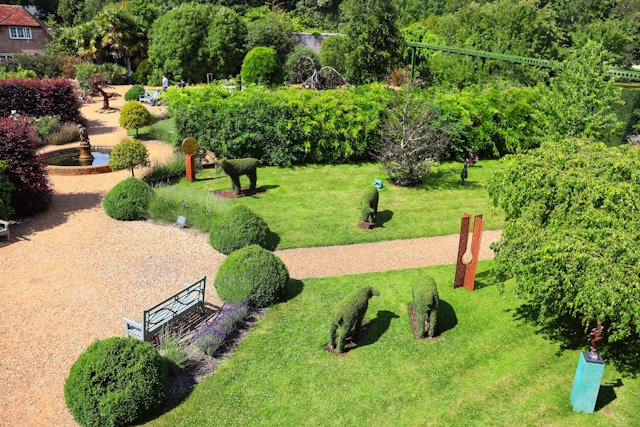
There is a garden in a village near where I grew up that you can smell before you can see. Honeysuckle in early summer, woodsmoke from the firepit in autumn, the dense, mineral coolness of damp stone after rain.
You round the bend in the lane and the garden announces itself before you have caught sight of a single plant.
I have never seen a photograph of it.
I am not sure a photograph would do anything for it.
For the last fifteen years or so, garden design has been pulled steadily towards the lens. The before-and-after reveal. The drone shot. The carefully styled corner with the cushion arranged just so.
Spaces have been built for how they will look from a single fixed point, on a clear day, in summer, between two and four in the afternoon.
The rest of the time, which is most of the time, they exist in a kind of suspended animation, waiting to be photogenic again.
This is a strange way to design anything, really, but it is a particularly strange way to design a garden.
Read more: How to Properly Maintain Your Yard?
The garden that cannot be photographed
A garden is the only part of a property that engages every sense at once.
The visual register is the one that translates best to photographs, which is presumably why it has come to dominate.
But it is also the most superficial.
The deeper experience of a garden is olfactory, tactile and auditory, and none of those things show up on a screen.
The scent of box hedging warmed by the afternoon sun. The crunch of gravel underfoot at a particular weight and grade. The almost imperceptible rustle of stipa in a light wind. The sudden cool that comes when you step into the shade of a mature tree on a hot day.
These are the things people remember about a garden a decade after they have left it.
None of them photograph.
“This is what sets a garden apart from every other element of a property, it lives, breathes, and reaches out to meet you,” says Mark Wright from Umber Garden Design, a designer and landscaper based in Warwickshire. “Gardens assault our senses in the most wonderful ways, often without requiring us to physically enter them at all. A view glimpsed through a winter window. The brush of foliage against your hands as you pass. Or a perfume that transforms the entire space into something magical.”
That last image is worth pausing on.
A garden that transforms a space through scent alone is not a garden you have looked at. It is a garden you have stood in, or walked past, or opened a window onto.
The experience is something the camera was never going to capture in the first place.
What we lose when we design for the lens
The instagrammable garden has become a recognisable type.
Pale paving, a defined seating area, repeat planting in matching planters, a single architectural specimen as a focal point, lighting that picks it all out at dusk.
It is a perfectly legitimate aesthetic. But it tends to sacrifice the things that make a garden a garden over time.
Scented planting often loses out, because the most beautifully fragrant shrubs are not always the most photogenic ones.
Honeysuckle is a sprawling, sometimes scruffy presence on a fence. Sarcococca is a modest, low-growing winter performer. Lavender works hard for the camera but most of the year it is a grey-green clump.
The plants that earn their place sensorially are not always the plants that earn their place visually.
The case for paying attention
There is something else going on here, beyond aesthetics. The visual-first garden trains its owner to relate to the space as a viewer.
You stand at the kitchen window. You sit on the bench at the photographable angle. You evaluate, you compose, you appreciate.
A sensory garden trains its owner to relate to the space as a participant.
You walk through it with your eyes half-closed because the scent of jasmine is doing the work. You crouch at the pond edge in spring because the sound of the frogs is suddenly extraordinary. You stop on the path because the gravel underfoot has changed grade and that small mechanical fact has caught your attention.
These are small things. They are also the entire point.
The gardens that move people, the ones they talk about years later, are almost always sensory gardens.
They may also be beautiful to look at, but the looking is the thinnest layer of the experience.
Building for the dark and the rain
A useful test for any garden design is to ask how it performs in the conditions it was not designed for.
How does it feel in November, when the photographs were never going to happen anyway?
What does it smell like in the dark, walking out to the bins at six in the morning?
What does it sound like in a downpour, from inside the house, with the windows shut?
The visual-first garden tends to fail these tests, because they were not really part of the brief.
The sensory garden, by contrast, often comes into its own.
A winter-flowering viburnum is not much to look at from twenty feet away. Walk past it in the cold dark on the way to the car, though, and it can stop you in your tracks.
That is the moment the design has earned its keep. Not in the photograph. In the actual living.
The slow case for substance
None of this is an argument against good-looking gardens. A garden should be beautiful to be in, and beauty is partly visual.
But it is also an argument that we have been overweighting one register at the expense of all the others, and that the most enduring gardens are the ones where the visual is the surface and the rest of the senses do the deeper work.
That is harder to brief, harder to design and almost impossible to communicate in a single photograph. It is also, by some distance, what people actually want from the gardens they will spend their lives in.
The best garden designers have always known this. It is just that for a while, the rest of us forgot to listen.
