

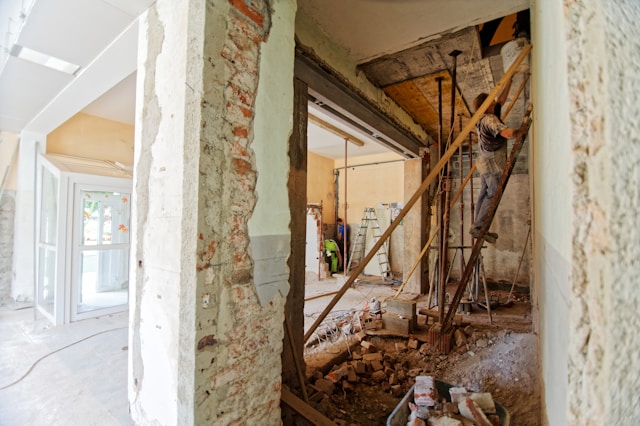
In mature real estate markets such as the United States and Western Europe, property value is no longer defined only by location or architectural prestige. Increasingly, it is determined by adaptability, technical relevance, and the ability of a space to respond to evolving economic and lifestyle demands. Within this context, renovation has shifted from a maintenance activity to a structured financial strategy.
Renovation is no longer a cosmetic upgrade — it is a financial repositioning tool that directly affects asset liquidity.
Modern investors and property owners now treat renovation services as a high-yield strategic instrument. Instead of allowing assets to depreciate through technical obsolescence, capital is actively reinvested into modernization, ensuring sustained competitiveness in the premium segment of the market.
In high-end real estate, time-to-market can influence ROI as much as location or square footage.
The logic behind this approach is simple: outdated infrastructure reduces both usability and perceived value. As buyer expectations evolve, properties that fail to meet modern standards experience slower transaction cycles and lower marketability.
Read more:
1. Thinking Of Home Renovation? Find An Experienced Civil Contractor With The Help Of This Guide
2. Key Points To Consider With Home Renovation
The Financial Logic Behind Renovation as an Investment Tool
A structured approach to renovation is built on three key pillars: technical modernization, spatial optimization, and aesthetic repositioning. Together, these elements form the foundation of long-term property appreciation.
Technical upgrades often deliver the highest hidden ROI by reducing future operational risks.
In premium segments, buyers evaluate not only design quality but also engineering integrity. Electrical systems, HVAC performance, insulation efficiency, and water infrastructure directly impact perceived asset quality.
| Renovation Element | Market Impact | Investment Effect |
|---|---|---|
| Technical Modernization | Higher buyer confidence | Reduced operational risk |
| Spatial Optimization | Improved usability | Increased functional value |
| Aesthetic Upgrading | Stronger first impression | Faster sales cycle |
This structured alignment between design and financial performance defines the modern interpretation of renovation as a capital tool rather than a construction expense.
Outdated infrastructure is one of the most underestimated value-degrading factors in luxury real estate.
Speed, Adaptability, and Market Timing
One of the most critical advantages of renovation over new construction is speed. In dynamic real estate environments, delayed execution can lead to missed market cycles and reduced return potential.
Speed is not just operational efficiency — it is a financial advantage in volatile markets.
Adaptive reuse of existing structures allows investors to bypass time-intensive foundational phases. This creates a faster path to revenue generation, especially in urban centers with high demand volatility.
- Reduced permitting complexity compared to new construction
- Faster asset activation after completion
- Lower exposure to market timing risks
Structural Transformation and Value Repositioning
In advanced cases, renovation extends beyond surface upgrades and enters the domain of remodeling projects involving structural changes and functional reconfiguration.
Functional zoning is now one of the most important drivers of luxury property valuation.
Modern lifestyles demand flexible environments that integrate work, leisure, and wellness within a unified spatial logic. Properties that fail to support these lifestyle scenarios tend to lose competitiveness in premium segments.
Expert Perspective on Strategic Renovation
Updating an interior or restoring a house is a challenge that requires greater creativity due to significant constraints, notes Tetiana Oliinyk, founder of OLT DESIGN. “But the incomparable satisfaction of seeing a renewed space given a second chance is worth it.
This statement reflects a core reality of contemporary architectural practice: renovation is fundamentally different from new construction because it operates within predefined structural, technical, and regulatory boundaries. Unlike a blank architectural canvas, existing buildings impose a series of constraints that must be strategically navigated rather than eliminated.
Updating an interior or restoring a house is a challenge that requires greater creativity…

Strategic renovation begins not with design freedom, but with constraint analysis — understanding what cannot be changed is as important as defining what can be improved.
From an expert standpoint, these constraints typically include load-bearing structures, existing инженерные системы, façade limitations, ceiling heights, and zoning regulations. Each of these elements defines a fixed framework within which all design decisions must operate. However, rather than limiting potential, this framework often becomes a catalyst for more sophisticated architectural solutions.
In high-end residential and commercial projects, experienced architects interpret these limitations as an opportunity to create higher-order design intelligence. Instead of relying on expansion or reconstruction, value is generated through optimization of internal logic — how space is organized, how circulation flows, and how functional zones interact with one another.
Constraint-driven design often produces more refined and context-sensitive interiors than unrestricted architectural development.
According to architectural analysts, this approach signals a broader transformation within the industry. Renovation is no longer perceived as reactive maintenance — a corrective response to wear and degradation — but rather as a proactive mechanism for recalibrating the performance of real estate assets.
In financial and architectural terms, this shift is significant. A well-executed renovation directly impacts three core dimensions of property value:
- Functional efficiency: improving how space is used through optimized layout and zoning strategies
- Technical reliability: upgrading infrastructure to reduce long-term operational risk and maintenance costs
- Market perception: aligning visual and experiential qualities with contemporary luxury standards
In premium real estate markets, perception often translates directly into price elasticity and transaction speed.
This conceptual shift also redefines the role of the architect. Rather than functioning solely as a designer of space, the architect becomes a strategic interpreter of value — translating physical constraints into opportunities for financial and experiential enhancement. The success of a renovation project is therefore measured not only by aesthetic outcome, but by its impact on asset performance.
Within this framework, “controlled transformation” becomes a more accurate definition of modern renovation practice. It emphasizes deliberate decision-making, where every modification is evaluated through multiple lenses: structural feasibility, economic efficiency, and long-term adaptability.
Modern renovation is less about rebuilding spaces and more about re-engineering their value logic.
Ultimately, the expert perspective highlights a fundamental evolution in the industry: buildings are no longer static objects, but dynamic assets capable of continuous recalibration. In this context, renovation becomes an instrument of architectural intelligence — a disciplined process that aligns physical form with economic performance and contemporary lifestyle expectations.
Ignoring modernization cycles in premium real estate leads to structural depreciation of both value and competitiveness.
Remodeling Projects as Long-Term Capital Strategy
Beyond renovation, remodeling projects represent a deeper level of transformation where layout, structure, and internal logic are redefined. This approach is often used to align properties with contemporary expectations of luxury living.
| Aspect | Renovation | Remodeling Projects |
|---|---|---|
| Scope | Surface-level improvements | Structural reconfiguration |
| Investment Depth | Moderate | High |
| Market Impact | Incremental value increase | Significant repositioning |
In many cases, remodeling delivers stronger long-term returns because it allows full alignment between architectural structure and user behavior patterns.
Conclusion: Renovation as an Engine of Architectural Equity
In modern real estate economics, value is actively constructed rather than passively preserved. Strategic renovation transforms underperforming assets into competitive market offerings through a combination of technical modernization, spatial intelligence, and aesthetic refinement.
Well-executed renovation functions as a direct mechanism for increasing architectural equity and long-term liquidity.
When viewed through an investment lens, renovation is not a cost center but a structured financial instrument capable of reshaping both physical space and capital performance in competitive global markets.
Architect Daniel Morgan:
Rating: ★★★★★ 5/5
One of the most accurate explanations I’ve read about renovation as a financial instrument rather than just construction work. The idea that renovation services directly influence architectural equity and liquidity is exactly how the industry is evolving. This aligns perfectly with modern luxury development strategies in European and US markets.
Was this review helpful?YES (18) / NO (0)
Real Estate Investor Sofia K.:
Rating: ★★★★★ 5/5
The breakdown of remodeling projects as a long-term investment strategy is extremely relevant. In my portfolio, properties that underwent strategic renovation services consistently showed faster appreciation and higher liquidity compared to untouched assets.
Was this review helpful? YES (22) / NO (1)
Interior Consultant Laura Bennett:
Rating: ★★★★☆ 4/5
Strong perspective on technical modernization and spatial optimization. I would add more emphasis on emotional design impact, but overall the article correctly positions renovation as a controlled transformation of space and value.
Was this review helpful?YES (14) / NO (2)
Property Developer James Carter:
Rating: ★★★★★ 5/5
This reflects exactly what we see in high-end redevelopment projects. Renovation services – https://oltdesign.com/services/renovation-reconstruction-refit/ are now the fastest way to reposition underperforming assets in competitive urban markets like London and New York.
Was this review helpful? YES (31) / NO (0)
Architectural Blogger Nina Roberts:
Rating: ★★★★★ 5/5
Excellent explanation of remodeling projects as a tool for structural and functional reconfiguration. The concept of lifestyle scenarios is especially relevant in modern residential design discourse.
Was this review helpful? YES (19) / NO (1)
Urban Investment Analyst Mark Evans:
Rating: ★★★★★ 5/5
The article clearly frames renovation as a financial lever rather than a construction expense. This perspective is critical for institutional investors evaluating long-term asset performance.
Полезен ли отзыв?YES (27) / NO (0)
Luxury Home Owner Elena V.:
Rating: ★★★★☆ 4/5
Very insightful perspective on property appreciation. I would personally like more examples of real projects, but the strategic framing of renovation services is extremely relevant for high-end homeowners.
Was this review helpful?YES (12) / NO (3)
Commercial Property Manager Thomas Reed:
Rating: ★★★★★ 5/5
This aligns with our experience in commercial assets. Strategic renovation services (https://oltdesign.com/services/renovation-reconstruction-refit/ ) significantly reduce vacancy periods and improve tenant quality in competitive markets.
Was this review helpful?YES (21) / NO (0)
Architectural Researcher David Lin:
Rating: ★★★★★ 5/5
A strong articulation of renovation as controlled transformation. It correctly positions design-led modernization as a discipline that integrates architecture, engineering, and investment strategy.
Was this review helpful? YES (30) / NO (1)