

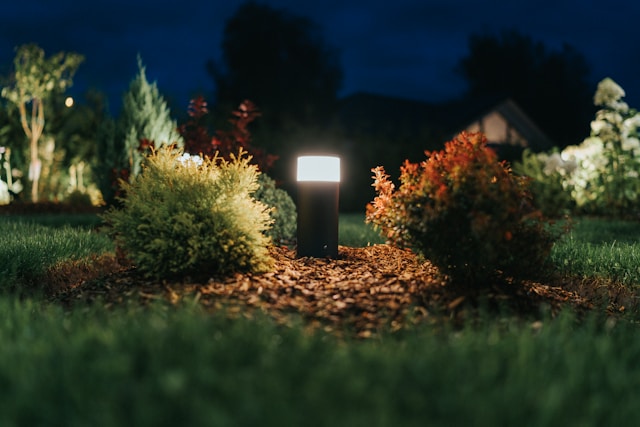
Gardeners think about light constantly: hours of sun, aspect, shade maps, the slow seasonal swing of the arc overhead. Then the sun goes down and most of us stop thinking about light altogether, or we bolt on a floodlight that turns a carefully composed garden into a car park. Outdoor lighting deserves the same horticultural thinking as planting design, because done well it extends your garden’s life deep into the evening, and done badly it can genuinely stress the plants you have spent years nurturing.
Yes, Night Lighting Affects Plants
Plants keep time by darkness. Photoperiodism, the mechanism by which species measure night length, governs flowering in many ornamentals and edibles. Short-day plants such as chrysanthemums, poinsettias and some salvias initiate flowering only when nights are long and uninterrupted, so a bright light burning beside them all night can delay or suppress blooming entirely. Research on street lighting has shown that trees under constant illumination hold their leaves longer into autumn and can become more vulnerable to seasonal stress. Night lighting also reshapes the insect life a garden depends on, drawing moths and other pollinators away from the plants they would otherwise visit.
The practical translation for home gardens is reassuring, though: intensity and duration matter far more than mere presence. Low-level, warm, downward-directed light on timers is a world away from an all-night floodlight. You can have a beautifully lit garden and happy plants. It simply takes a few deliberate choices.
Read more: Modern Outdoor Wall Lighting Ideas In 2022
Plant-Friendly Lighting Principles
Go warm. Choose lamps in the 2700K to 3000K range. Warmer light contains less of the blue wavelength that most strongly interferes with plant, insect and human circadian responses, and it is far more flattering to foliage, timber and stone anyway. Save cool white for the workshop.
Light downward, and shield it. Full cut-off and hooded fittings put light on paths and plantings rather than into the sky and your neighbour’s bedroom window. Uplighting has its place, perhaps a sculptural frangipani or a paperbark trunk, but use it sparingly and aim it tight, because every stray beam is wasted power and lost darkness.
Use timers and sensors ruthlessly. The garden does not need light at three in the morning. Timers that cut ambient lighting by ten or eleven at night give photoperiod-sensitive plants their darkness while covering the hours you are actually outside. Motion sensors handle security duties without a permanent glow, and they startle possums far more effectively than a constant floodlight they simply learn to ignore.
Keep intensity honest. You need far less light outdoors than instinct suggests. Dark-adapted eyes find a three watt path light generous. Layered low-output fittings beat one powerful source every time, for the plants, the power bill and the atmosphere.
The Subtropics Raise the Stakes, and the Rewards
In warm climates the garden functions as an evening room for most of the year, which is why outdoor lighting is close to a default feature in subtropical Australian landscapes. The same climate raises the technical bar. Coastal humidity, salt-laden air, storm-season downpours and irrigation overspray demand marine-grade fittings rated IP65 or better, corrosion-resistant metals such as 316 stainless or copper, and properly protected circuits. The bargain fittings that survive for years in Melbourne can be pitted and failing within eighteen months near the beach.
This is also the point where garden lighting stops being a hardware-store project. In Queensland, 240 volt garden lighting must be installed by a licensed electrician, and even extensive low-voltage systems benefit from professional design, because voltage drop across long garden runs is the classic cause of the sad, dim fitting in the far corner. Landscape-focused electrical firms that handle outdoor lighting Gold Coast will design the circuits, transformer placement and weatherproofing to suit the actual conditions rather than the catalogue photo.
A Simple Scheme That Works Almost Anywhere
- Paths and steps: low bollards or recessed step lights, warm white, shielded. Safety first, ambience second.
- One or two heroes: a single uplit feature tree, or a grazing light across a textured wall or water feature. Restraint is what makes a scheme read as designed rather than decorated.
- The sitting zone: festoons or wall lights on a dimmer near the table or fire pit, switched separately so the rest of the garden can rest dark.
- Working light on sensors: the genuinely bright fittings, over the barbecue, the shed door and the bins, motion-activated only.
Wire the zones separately and you can run a soft “evening” scene most nights, saving full illumination for entertaining, and saving true darkness for the plants.
On running costs, there has never been a better time to light a garden. LED efficiency means an entire layered scheme can draw less power than a single old halogen floodlight. The Australian Government’s household guidance at energy.gov.au covers lighting efficiency in detail, and the gap between LEDs and everything that came before them is dramatic, especially for fittings that run every night of the year.
The Grower’s Bottom Line
Treat light after dark the way you treat water: essential in the right dose, harmful in excess, best delivered deliberately. Warm, low, shielded and on a timer keeps the chrysanthemums flowering, the moths and fireflies happier, and the garden looking like somewhere you want to be at eight in the evening. After all the weeding and mulching, that is rather the point.
